The Numbers Don’t Lie: How Real Estate Staging Impacts Your Home Sale
When you’re preparing to sell your home, every decision matters. You’ve likely heard that staging can help, but what does the actual data tell us? Understanding the real impact of a real estate staging service can transform how you approach your home sale—and potentially save you thousands of dollars while reducing stress during an already overwhelming transition.
If you’re a homeowner in Park City, Utah preparing to list your property, the statistics surrounding professional staging reveal why this investment consistently delivers measurable returns. At Organized to Live Well, we’ve seen firsthand how data-backed staging strategies create spaces that resonate with buyers and accelerate sales.
What the Research Reveals About Staged Homes
Staged Homes Sell Faster
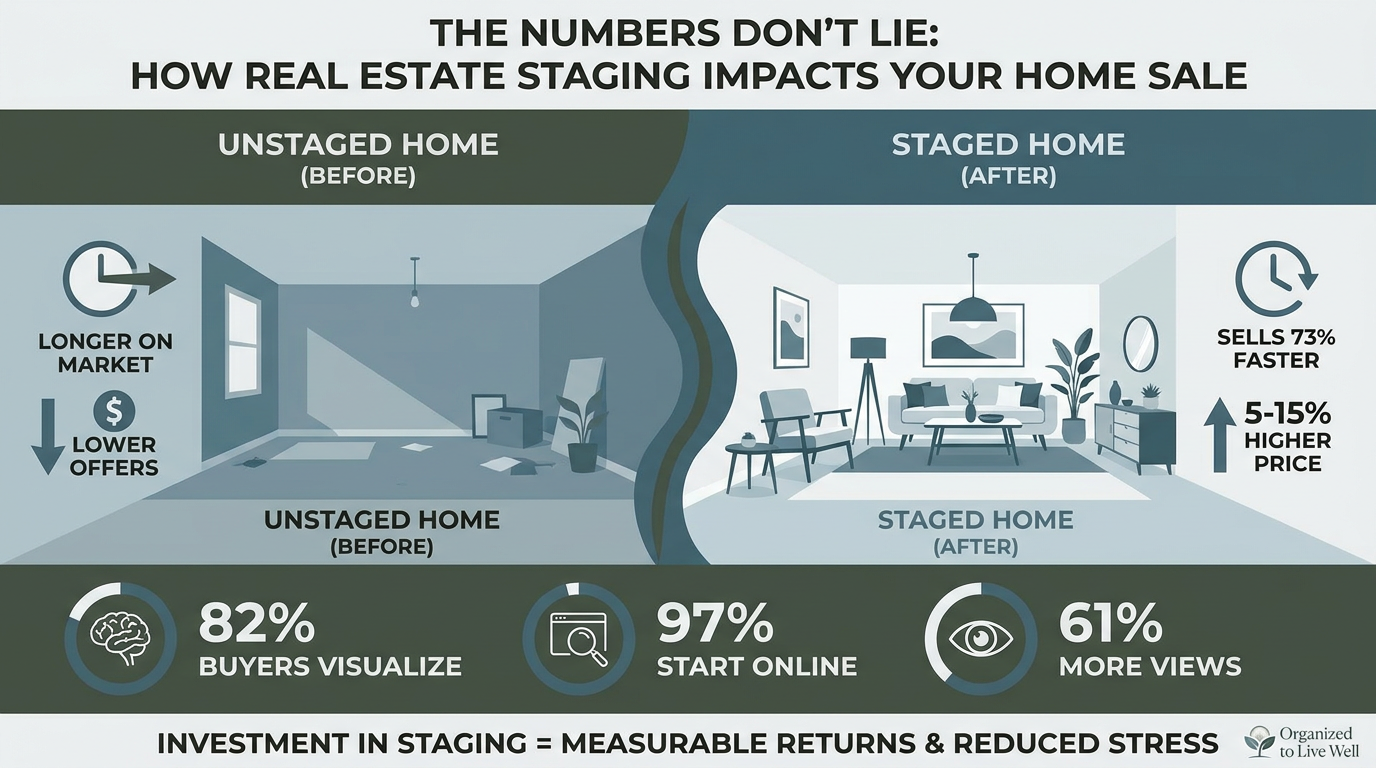
The National Association of Realtors consistently reports that staged homes spend significantly less time on the market. According to their research, 82% of buyers’ agents say staging makes it easier for buyers to visualize the property as their future home. When buyers can picture themselves living in a space, they move from browsing to buying.
Homes that sit on the market accumulate carrying costs—mortgage payments, utilities, insurance, and property taxes. Each additional week your home remains unsold adds to these expenses. The data shows that professionally staged homes often sell 73% faster than non-staged properties, directly impacting your bottom line.
Price Points Tell a Compelling Story
Multiple industry studies demonstrate that staging influences final sale prices. The Real Estate Staging Association found that staged homes sell for 5-15% more than unstaged comparable properties. On a $750,000 home, that difference represents $37,500 to $112,500—a substantial return on a staging investment that typically costs a fraction of that amount.
Buyers make emotional decisions backed by logical justifications. When they walk into a thoughtfully staged home, they perceive higher value. This perception translates directly into offers that reflect the home’s full potential rather than requiring buyers to imagine what could be.
First Impressions Happen Online
In today’s market, 97% of buyers begin their home search online. Your listing photos create the critical first impression, and staged homes photograph dramatically better than empty or cluttered spaces. Listings with professional staging photos receive 61% more views than non-staged listings.
More views mean more potential buyers walking through your door. Each additional showing increases the likelihood of multiple offers, which can drive your final sale price even higher than asking.
The Psychology Behind Staging Success
Buyers Need Help Seeing Possibility
Empty rooms appear smaller and less inviting. Cluttered spaces overwhelm potential buyers and prevent them from focusing on your home’s best features. Professional staging creates a neutral, aspirational environment that appeals to the broadest range of buyers.
When furniture is properly scaled and positioned, rooms feel larger and more functional. Strategic styling draws attention to architectural details, natural light, and flow between spaces. These elements combine to create an emotional response that generic, unstaged spaces simply cannot achieve.
Reducing Buyer Objections
Staging addresses potential objections before buyers voice them. An awkwardly shaped room becomes a cozy reading nook. A basement transforms from storage space to a functional home office. By demonstrating how spaces can be used, staging eliminates the mental work buyers would otherwise need to do—and the doubts that accompany uncertainty.
Real Estate Staging Service in Park City: Local Market Considerations
The Park City market presents unique opportunities and challenges. Buyers in this area often have high expectations for quality and design. They’re accustomed to well-appointed spaces and appreciate attention to detail.
Mountain homes require staging that honors their architectural character while showcasing lifestyle appeal. Whether your property features rustic beams, expansive windows with mountain views, or modern alpine design, professional staging enhances these distinctive elements rather than competing with them.
Seasonal considerations also matter. Staging that emphasizes cozy gathering spaces resonates during ski season, while summer staging might highlight outdoor connections and natural light. Understanding these nuances requires local expertise and strategic thinking.
What Professional Staging Actually Involves
Initial Assessment and Strategy
A comprehensive staging consultation begins with evaluating your home’s strengths and addressing any elements that might distract buyers. This includes:
- Identifying which existing furniture and decor should remain
- Recommending items to remove or store
- Suggesting minor repairs or updates that deliver maximum impact
- Creating a room-by-room staging plan
Implementation That Respects Your Privacy
Professional stagers work efficiently to transform your space while respecting your privacy and schedule. The process typically includes decluttering, rearranging existing furniture, bringing in rental pieces as needed, and adding finishing touches that create visual appeal.
Quality staging isn’t about creating a showroom—it’s about helping buyers connect emotionally with your home while showcasing its functionality and flow.
Photography-Ready Results
Once staging is complete, your home is ready for professional photography that will attract online viewers and generate showings. The investment in real estate staging services works synergistically with quality listing photos to position your property competitively.
Cost Versus Return: Making the Numbers Work
Staging costs vary based on your home’s size, condition, and the scope of work required. However, even conservative estimates show positive returns. If staging costs $3,000-$5,000 and helps your home sell for even 3% more, you’ve gained $22,500 on a $750,000 property—a return of 450-750% on your staging investment.
Beyond the financial return, consider the value of reduced stress and faster transitions. Carrying costs, both financial and emotional, decrease dramatically when your home sells quickly.
Common Misconceptions About Staging
“My Home Looks Fine As-Is”
You’ve lived in your home and love it—but buyers are evaluating it with fresh, critical eyes. What feels comfortable and familiar to you may read as dated or cluttered to someone seeing it for the first time. Staging creates the neutral, aspirational environment that allows buyers to project their own vision.
“Staging Is Only for Luxury Homes”
Data shows staging benefits homes at every price point. In fact, mid-range properties often see the most dramatic impact because staging helps them compete with newer construction and move-in-ready alternatives.
“Empty Homes Show Better”
Research consistently contradicts this assumption. Empty homes feel cold, appear smaller, and make it difficult for buyers to understand scale and functionality. Proper staging solves all these issues.
Taking the Next Step
If you’re preparing to list your home, the data makes a compelling case for professional staging. The combination of faster sales, higher prices, and reduced carrying costs creates a clear path to better outcomes.
Life transitions are challenging enough without the added stress of a prolonged home sale. Whether you’re downsizing, relocating, or moving through a major life change, professional staging removes obstacles and creates momentum.
Ready to see what staging can do for your home sale? Contact us today to schedule your consultation and discover how strategic staging transforms properties into must-see listings that buyers remember—and make offers on.
Frequently Asked Questions
How long does the staging process typically take?
Most homes can be staged within 1-3 days, depending on size and scope. The initial consultation takes about an hour, during which we’ll assess your space and create a customized plan. Implementation timing is scheduled around your needs and listing timeline, ensuring your home is photo-ready when you need it.
Should I stage before listing or wait to see if my home sells?
Staging before listing delivers the best results. Your listing photos create the critical first impression that determines whether buyers schedule showings. Once your home has been on the market without staging, it’s already accumulated days on market and may have been passed over by buyers who made judgments based on unstaged photos. Starting strong positions you for success from day one.
What’s the difference between staging and decorating?
Decorating reflects personal taste and creates spaces for daily living. Staging is a strategic marketing tool designed to appeal to the broadest range of potential buyers. Staging uses design principles to highlight your home’s best features, create emotional appeal, and help buyers envision themselves in the space—all with the specific goal of facilitating a faster sale at the best possible price.